Recently, Wang Yifeng, an academician team of Tong Zhenhe, Shandong University, published a paper in the Journal of the American Chemical Society (J.Am.Chem.Soc.2017, http://dx.doi.org/10.1021/jacs.7b10565) under the title "Titanium-Oxide Host Clusters with Exchangeable Guests".
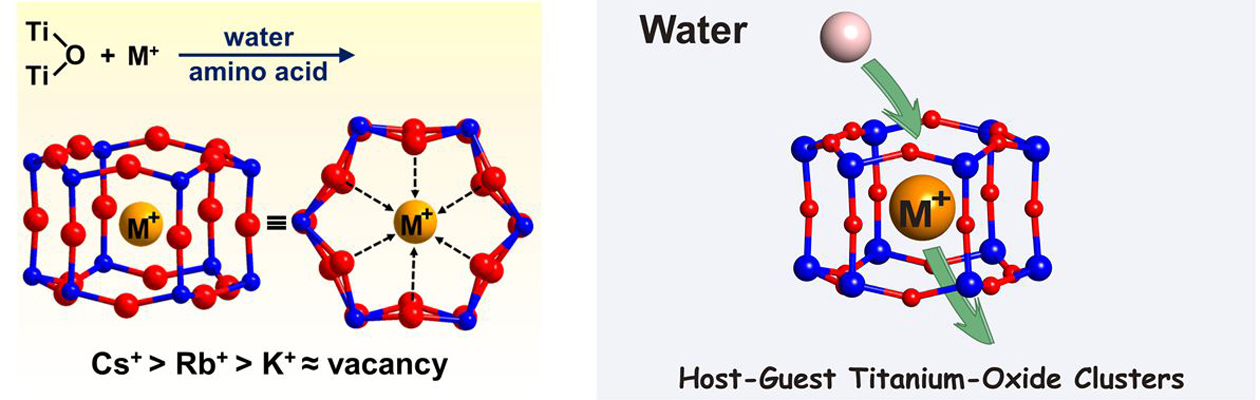

In the history of supramolecular chemistry, with crown ethers being synthesized in 1967, scientists have devoted a great deal of attention to the synthesis of different types of organic host molecules (characterized by the ability to identify and capture guest molecules matching their size). The synthesis of inorganic crown ether analogues has also attracted extensive interest of scientists, but few inorganic molecular compounds have been reported that can recognize and capture the guest. The first case of inorganic hole ether analogue {Ti12} has been reported. Its structure is similar to that of titanate (infinite structure). It can selectively capture monovalent cations such as Cs+, Rb+, K+, hydrated protons and so on. The flexible pore of {Ti12} expands as the larger guest molecule passes through and shrinks after the guest molecule enters, thus confining the guest molecule to the cage.
